

Thursday seminar: BIFD Sandrine Baume + BIFD Cristina Leston-Bandeira
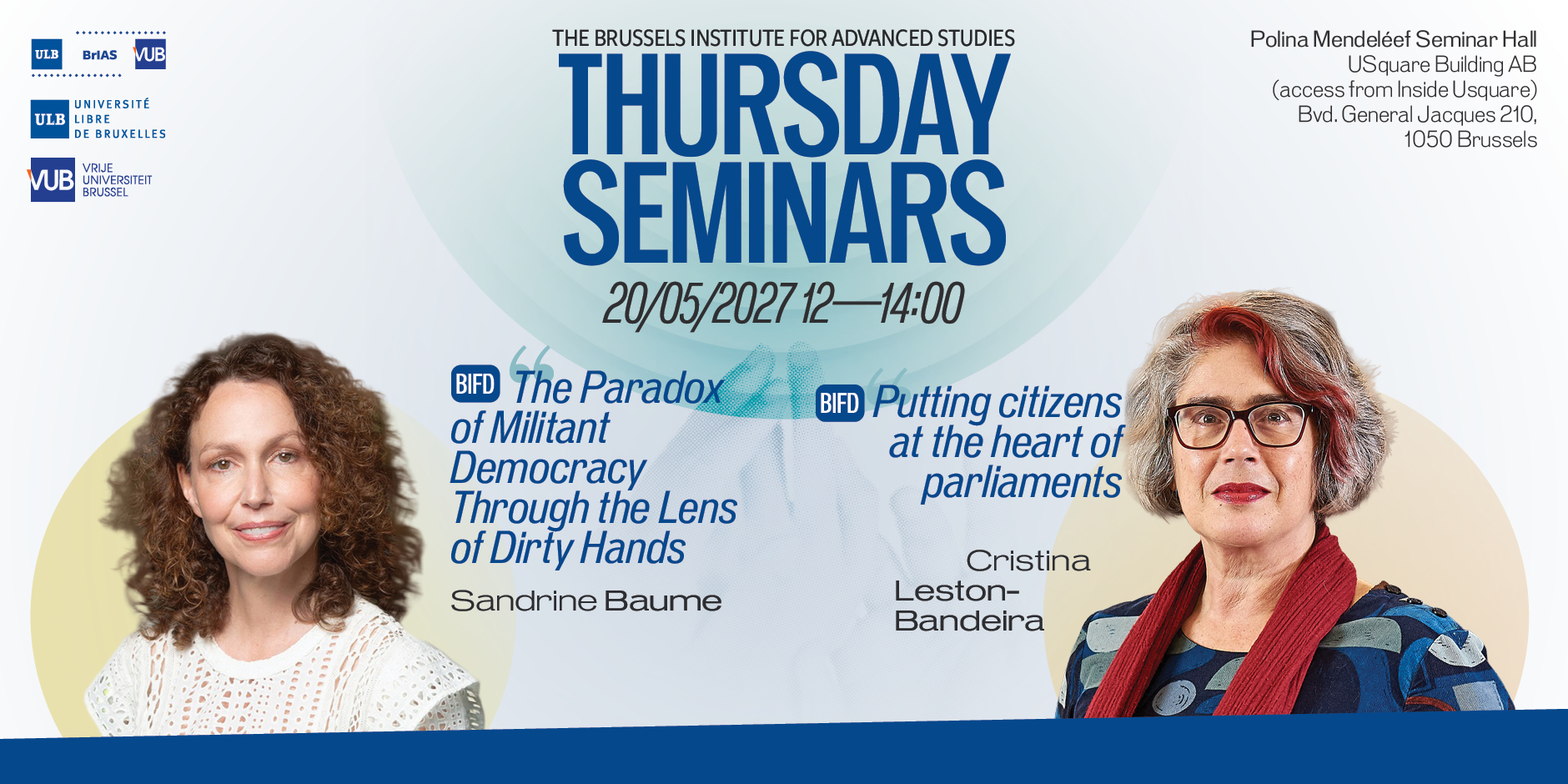
The Paradox of Militant Democracy Through the Lens of Dirty Hands
by Sandrine Baume
The idea that democracy may need to protect itself against actors seeking to undermine it from within lies at the heart of militant democracy. Yet militant democracy raises a fundamental normative problem: how can democracies defend themselves against forces exploiting democratic rights for antidemocratic purposes without themselves violating those rights? This tension has been described as the “paradox of democratic self-injury.” Existing scholarship has generally adopted two contrasting positions. Some regard the paradox as insurmountable and therefore reject militant measures as incompatible with democratic principles. Others consider it surmountable, apparent, or essentially pragmatic, and argue that suitably constrained militant measures can be justified.
This paper develops a third approach by interpreting the paradox of democratic self-injury as a “dirty hands” scenario. Such scenarios involve genuine moral conflicts in which competing values cannot be fully reconciled. Militant democracy, we argue, confronts democracies with a conflict between political self-determination, requiring free political competition, and the preservation of stable democratic institutions, which may require restricting that competition. This perspective acknowledges the genuine moral costs of militant measures while allowing for their qualified justification. It also implies that such measures require compelling evidence of a serious threat to democratic institutions and must remain sensitive to the moral risks inherent in defending democracy.
Bio
Sandrine Baume is a Full Professor at the University of Lausanne. Her research lies at the intersection of democratic theory and the history of political thought. She has focused in particular on institutions (such as constitutional courts), key actors (such as political parties), principles (including transparency and democratic self-defence), and practices (such as political compromise). Her extensive knowledge of legal scholars from the Weimar Republic has played apivotal role in shaping her research and publications.
More recently, she has broadened her research to examine the political competence of people with intellectual disabilities, with particular attention to the role that the concept of autonomy plays in this debate.
Putting citizens at the heart of parliaments
by Cristina Leston-Bandeira
Are parliaments at risk of becoming irrelevant to our democratic political systems? Trust in parliament has been in acute decline for some time and decision-making power has decisively shifted to executive institutions, if not to supra-national private commercial companies with far more power political institutions. In increasingly complex societies where information is characterised by noise and polarisation, political institutions struggle to communicate with the people they are accountable to. In all likelihood, parliaments are invisible to the vast majority of people; either because they cannot dissociate them from governments and/or politicians in general, or simply because they really do not feature in their day-to-day life. In this talk I will reflect on the practical challenges that parliaments encounter to keep their relevance to people. This will include a reflection on the core characteristics of the institution of parliament which makes them destined to be unloved. I will review how parliaments have reacted to this so-called crisis of democracy. This will show the wide range of initiatives that parliaments have introduced particularly since the turn of the 21st century. I will reflect on the effectiveness of these and on the characteristics that hinder parliaments’ ability to connect and engage citizens meaningfully.
Bio
Cristina Leston-Bandeira is Professor of Politics at the University of Leeds, UK, and Co-Director of its Centre for Democratic Politics. Professor Leston-Bandeira has been instrumental in promoting research on the relationship between parliaments and citizens. Her pioneering work on symbolic representation and the way it facilitates public engagement has profoundly shaped the subfield of parliamentary research in the UK and beyond. The author of over 70 publications, Cristina has recently co-edited the highly innovative ‘Reimagining Parliament,’ which asks what Parliament should be in the 21st century and offers wide ranging suggestions for parliamentary reform. Leston-Bandeira was Chair (2020-26) and co-founder of the pioneering International Parliament Engagement Network (IPEN), having broken new ground as the first female academic Chair of the UK Study of Parliament Group (2019-22). She is a leading scholar on parliaments and public engagement and was awarded the UK Political Studies Association 2025 Sir Isaiah Berlin Prize for her outstanding professional contributions to political studies.