

Thursday seminar: Lala Muradova & Alberto López Ortega + Joke Mathieu
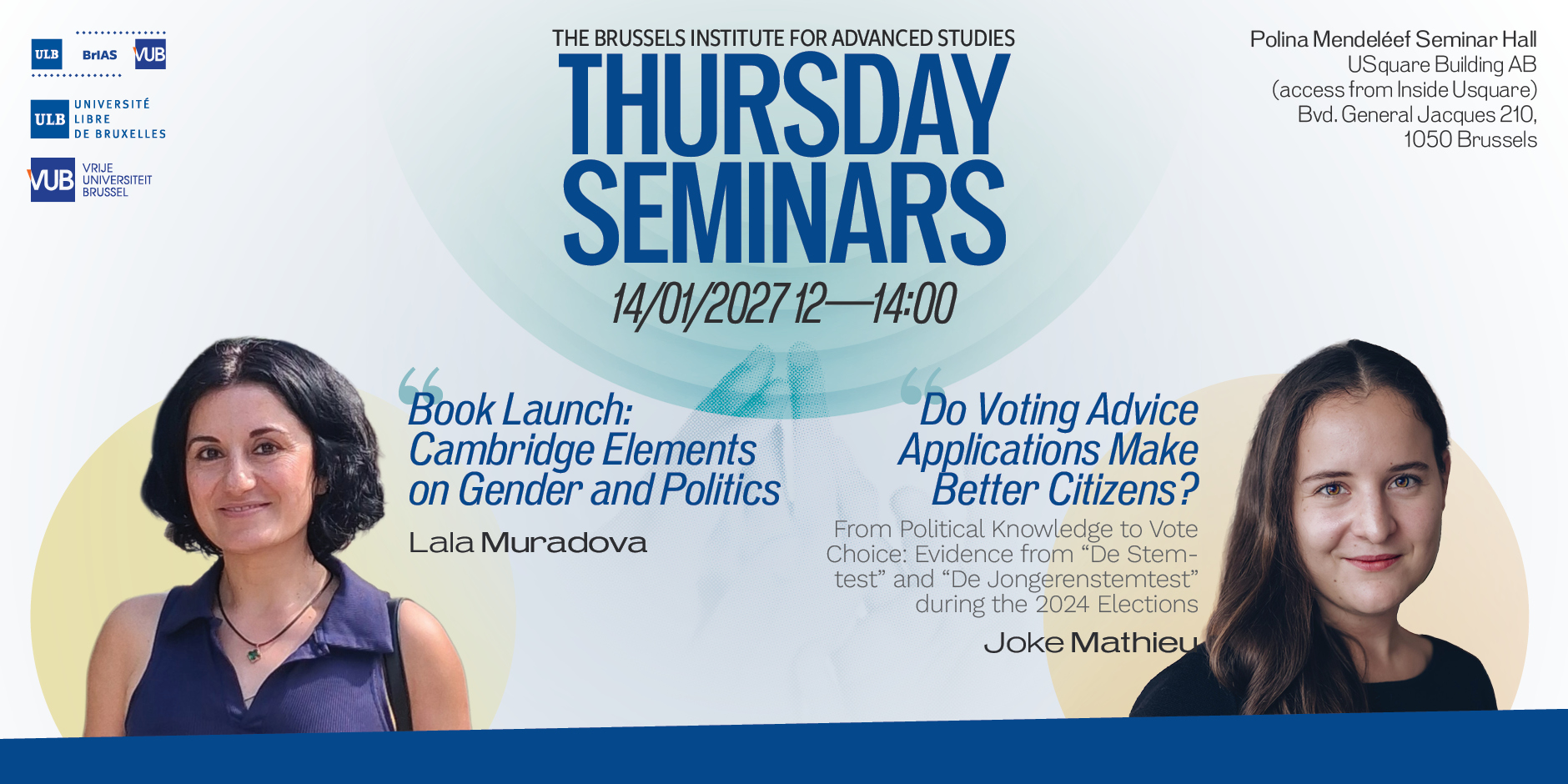
Book launch: Cambridge Elements on Gender and Politics
by Lala Muradova and Alberto López Ortega
This book argues that contemporary dating contributes to increasing gender-based political polarisation in modern societies. As heterosexual men’s and women’s political beliefs diverge, especially around feminism and gender equality, romantic encounters become sites of tension and conflict. Men often encounter women supporting (either directly or indirectly) feminist ideals, while women frequently face dismissive or sexist attitudes, fuelling frustration and hostility on both sides. These dynamics intensify political divides within intimate settings, shape individuals’ attitudes and reinforces broader societal polarisation. Our theoretical claims are tested through a multi-method design that combines survey and experimental data with quantitative text analysis of individual responses to an open-ended question from respondents in the UK. The findings highlight the role of romantic contexts in sustaining gendered political polarisation.
Bio
Lala Muradova is Associate Professor in Political Psychology and Democracy at the University of Southampton (UK), where she is a member of the steering committees of the Centre for Democratic Futures and the Centre for Behavioural Experimental Action and Research (C-BEAR). Her research sits at the intersection of political psychology, political communication, and democratic innovations.
Lala is the author of Empathy and Political Reasoning: How Empathy Promotes Reflection and Strengthens Democracy (Cambridge University Press, 2025), and of journal articles published in European Journal of Political Research, Political Communication, PLoS ONE, and Political Studies, among others. Dr Muradova holds a PhD in Social Sciences from KU Leuven, Belgium (2021), and her doctoral thesis received the 2021 Best Political Science PhD Award from the Belgian and Dutch Political Science Associations, as well as an honorary mention for the APSA/ICA Political Communication Dissertation Award.
Do Voting Advice Applications Make Better Citizens? From Political Knowledge to Vote Choice: Evidence from “De Stemtest” and “De Jongerenstemtest” during the 2024 Elections
by Joke Mathieu
Voting Advice Applications (VAAs) have become one of the most widely used information tools in election campaigns. Their democratic promise is considerable: VAAs are expected to inform voters, mobilize them, and help them vote in line with their preferences. Yet whether they deliver on these promises remains debated. This BrIAS talk brings together a series of studies on two real-world VAAs used during the 2024 Belgian elections: “De Stemtest” and the youth-oriented “De Jongerenstemtest”. Drawing on randomized experiments embedded in the YouVoice panel study of young citizens aged 16–30, complemented by panel data on natural VAA use during the campaign, it examines the influence on party position knowledge, ideological knowledge, turnout motivation, internal political efficacy, and party preferences. The findings show that VAAs can strengthen young voters’ political knowledge and engagement, particularly when the tool is tailored to a young audience, with some indications that less politically sophisticated users benefit most. The BrIAS talk concludes by discussing what these results imply for the democratic value of VAAs and for their design.
Bio
Joke Matthieu is a postdoctoral researcher at the Center for Democratic Futures (Vrije Universiteit Brussel) and the M2P research group (University of Antwerp). Her research interests include inequalities in political socialization processes and more general research on political behavior. She has published recently in the European Journal of Political Research, Politics and Gender, Political Behavior, and West European Politics.