

- This event has passed.
Public Lecture – Big Ideas for Democracy: Tània Verge
Register here
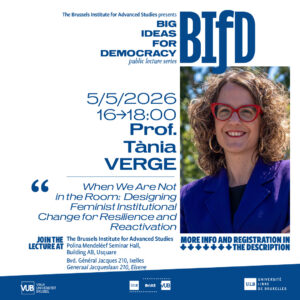
When We Are Not in the Room: Designing Feminist Institutional Change for Resilience and Reactivation
Feminist institutionalism has long shown that feminist institutional change is rarely one-shot, given the “genderedness” of organisations/institutions (Benschop & Verloo, 2006), the “nested newness” of reform efforts (Mackay, 2014), and multiple forms of resistance (Tildesley, Lombardo & Verge, 2022). Recent work argues that inclusive reforms tend to follow cycles of repetition through which change is sedimented (Cianetti, 2024). This resonates with Benschop & Verloo’s metaphor of “Sisyphus’ sisters” – organising so each restart begins from a slightly stronger position –, with Mackay’s (2014) memory-keepers who periodically force recollection, and with Sara Ahmed’s (2017: 12) insight that “repetition is the scene of a feminist instruction.”
The Catalan case offers unusually clear evidence that while feminist insider activists in executive office can rewrite the gendered rules of the game and effectively implement transformative state feminism, much feminist change remains deeply embodied – dependent on insider feminist activists’ presence at veto and coordination nodes, with sufficient expertise and overlapping membership in the feminist movement. Nearly two years on, following a change of administration, drift is very visible: new formal and informal gendered rules thin out or are abandoned, coordination venues are downgraded, veto power is not exercised, and technocratic “add-women-and-stir” mainstreaming is back.
From a dual practitioner-academic perspective as former Minister of Equality and Feminisms, Government of Catalonia (2021–2024) and feminist institutionalist scholar, this paper reflects on the extent to which feminist governance can be designed to endure in the absence of feminist insider activists or be relaunched swiftly when they are back in the room. In doing so, I discuss the gendered legacies seeded, including: entrenchment across venues and duplicated authority to counter “remembering the old”; memory infrastructures to counter “forgetting the new”; and broadened legitimacy coalitions/audiences to ease the “liability of newness” and embed new feminist logics of appropriateness. This reflection is particularly relevant amid the global dismantling, backsliding, and watering-down of feminist policies across governments – whether far-right or centre-left executives – as well as universities and other institutional arenas.
Bio
Tània Verge is a Full Professor of Politics and Gender at the Department of Political and Social Sciences, Universitat Pompeu Fabra (UPF, Barcelona), where she led the Equality Unit between 2014 and 2021 and coordinated the Minor in Gender Studies. Between May 2021 and August 2024, she served as Minister of Equality and Feminisms of the Government of Catalonia, and between May 2024 and February 2026 she was an MP in the Parliament of Catalonia. Her main area of research is gender and politics, with a focus on how political parties and parliaments are shaped by gender dynamics and on resistance to the adoption and implementation of equalities policies. Her consultancy and governmental practice have also given her new insights into the possibilities and limitations of feminist institutional redesign.