
With only a few months for the official start of the BrIAS Season, we are very excited to share with you the full details of the programme. You can download our informational brochure by clicking the button below.
Download the brochureBrIAS Senior Fellows of 2027
This Season, a total of 25 BrIAS Senior Fellows will stay with us from January to June, three of which (Liza Mügge, Marija Radoman and Tània Verge) are coming back after their 2026 BrIAS Fellowship. Hailing from all 5 continents, they are sure to deliver riveting talks during our many planned events and spark thoughtful debate that will no doubt enrich our joint efforts towards all aspects of sustainability in governance.
To learn more about our Fellows, head on over to the newly-redesigned BrIAS Fellow archive!
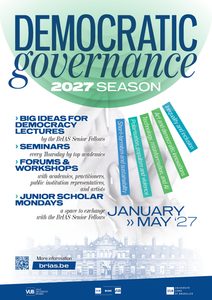
State of the Federation & 2027 Opening Ceremony
As is tradition now, we will officially inaugurate the 2027 Season on the 21st of January with an opening ceremony that will feature a few words from the BrIAS Programme Team, BrIAS Co-Directors and Vice Rectors. The official ceremony will conclude with a cocktail style reception. Stay tuned to be notified when the registrations open!
This year, the opening ceremony will be preceded by the conference Belgium: State of the Federation, coorganised with the Association Francophone de Sciences Politiques (ASBP) and the Vereniging voor Politieke Wetenschappen (VPW). Head over to the event page to stay updated!
Thursday Seminars and Big Ideas for Democracy
Every Thursday of the Season we will host our Thursday Lunchtime Seminars, where we invite top academics and practitioners to deliver a talk and treat the attendees to lunch and coffee. On 17 select dates, these seminars will include one (or two!) Big Ideas for Democracy, lectures delivered by our Senior Fellows about their research interests. Whether you are an academic, public servant, practitioner, or just interested in democratic governance, be sure to attend our these talks – be it online or via our YouTube channel. You can find the full list of BIfDs below:
| 02/02 | Living in an unequal world: Consequences for societies’ social and political vitality by Jolanda Jetten AI and the New Politics of Protective Epistemic Sovereignty by Andrew Chadwick |
| 11/02 | Violent Political Conflict by Stathis Kalyvas Collective Amnesia in Political Science Research by Frank Mols |
| 18/02 | Do the People Consider Democracies as More Reliable International Allies? by Yasin Koç |
| 25/02 | Democratic weaponizing: the challenge of the contemporary radical right by Oscar Mazzoleni |
| 02/03 | Institutionalizing Knowledge Diplomacy in Northeast Asia: Universities, Scholars, and Academic Cooperation Governance by Lizhou Wang |
| 02/03 | Do the People Consider Democracies as More Reliable International Allies? by Osman Sabri Kıratlı |
| 03/03 | “Fantasy” according to Fryderyk Chopin: A Comparative Study Using Subjects by George Sand and Adam Mickiewicz by Risa Matsuo |
| 04/03 | From Security Institution to Political Symbol: Political Polarization and the U.S.–South Korea Alliance: How has recent political polarization transformed existing interpretations of the U.S.–ROK alliance into competing political identities? by Jinwon Lee |
| 11/03 | The Politics of Recognition and its Limits: Cultural Diversity, Governance and Indigenous Self-Recognition in Canada by Mathieu Arsenault |
| 18/03 | Reimagining Governance on Mars and Earth. How Citizens Around the Globe Envision Future Institutional Designs by André Bächtiger Democratic myopia revisited: New causes and remedies for a blurry vision? by Maija Setälä |
| 25/03 | Masculine Power: Political Privilege and the Future of Democracy by Liza Mügge Democracy and LGBTIQ rights in Southeast Europe: Evidence from the European Social Survey and interviews with civil society activists by Marija Radoman |
| 08/04 | The City Revisited: Urban Self-government and European State-Formation by Jørgen Møller |
| 15/04 | The Representative is Present : Power, Politics and Democracy in The Square by Michael Saward |
| 22/04 | Exclusive Democracy? The Role of Political Parties in Mobilizing the Migrant Vote by Ekaterina Rashkova Challenging Patriarchy while Countering the Far Right: The Case for Feminist Policies for Men by Tània Verge |
| 05/05 | The Art of the Breach: Populism, Transgression and Performances the People by Theo Aiolfi |
| 15/04 | The changing landscape of party politics: a view from 5 continents by Susan Scarrow |
| 20/05 | The Paradox of Militant Democracy Through the Lens of Dirty Hands by Sandrine Baume Putting citizens at the heart of parliaments by Cristina Leston Bandeira |
| 25/05 | The role of emotional culture in building sustainable democracies by Alice Poma What is democracy for? Young people, development and the promise of a better future by Nana Akua Anyidoho |
Workshops & Forums
Other than our recurring Thursday Seminars, our Programme team has gone above and beyond by organising several big events on the topic of democratic governance:
| 21/01 | Conference ABSP x VPW x BrIAS – Belgium: The State of the Federation |
| 04-05/02 | Workshop Cerium x BrIAS – The End of Affective Polarization? |
| 02-04/03 | BrIAS x WIAS x ZuKo – Democratic Governance in Transition. Interdisciplinary Approaches to Polarization, AI, and Inclusion |
| 17-18/03 | Forum – Re-Designing Democracy: Spaces, Infrastructures, Institutions |
| 15/04 | Workshop – Democratic leadership |
| 13-14/04 | PPDB x BrIAS workshop – Political parties and democracy |
| 25/05 | Workshop – Future-oriented policymaking and foresight |
| 27/05 | Forum – Cities and democracy and Closing Ceremony |
Cities and Democracy & 2027 Closing Ceremony
The Closing Ceremony of this year will conclude the chapter of the ‘Democratic governance: challenges and innovations’ theme and will mark the beginning of the new theme. To bridge between the two, the current and future programme teams have collaborated to organise a forum where both themes intersect. More information will be available soon on the event page.